
Short answer: Better health care supports population growth mainly by helping people live longer, healthier lives. Stronger maternal and newborn care, wider use of vaccines, and earlier treatment of chronic conditions all raise life expectancy.
In the US, that shows up as an older population, not a population boom. Life expectancy reached 79.0 years in 2024, up from 78.4 in 2023, according to the CDC's National Center for Health Statistics. More people are living into their 70s and 80s, and most of them are managing at least one chronic condition.
For small and medium practices, this changes the daily work. Panels get older, visits get more complex, and more patients need follow-up between visits. This guide covers what's changing, what it means for your practice, and how to plan for it with population health.
Three ways better health care changes a population
1. Healthier starts to life. Better prenatal, delivery, and newborn care help more children grow into healthy adults.
2. Better protection from infections. Vaccines and antibiotics have made many serious illnesses preventable or treatable. Adult vaccines, like pneumococcal and flu shots, keep protecting people as they age.
3. Longer lives with chronic conditions. With regular care, patients can live well with diabetes, high blood pressure, or heart disease for many years, as long as their labs, medications, and screenings stay on track.
That third point is where primary care does most of its work today.
What the US population looks like today
The US population is gradually shifting toward older age groups. There were 61.2 million adults aged 65 and older in 2024, up 13% since 2020, according to the US Census Bureau.
Many of these patients benefit from ongoing care. In 2023, 78.8% of adults 65 and older had two or more chronic conditions, according to a 2025 CDC study. For them, regular labs, medication reviews, and screenings matter as much as visits for new concerns.
The change isn't even across the country. Some areas gain residents through jobs or retirement moves, while others lose them, so your local patient mix matters more than the national average.
What this means for your practice
- More follow-up work per patient. Patients with several conditions need regular labs, medication reviews, and screenings.
- More complex visits. A single visit may cover diabetes, blood pressure, and a medication question at once.
- Greater risk of missed care. As panels grow and age, it gets easier for a patient to slip through without anyone noticing.
- A closer link between quality and payment. Medicare and many commercial payers base part of their payment on quality measures, so staying current on screenings supports both patient care and practice revenue.
Public health vs. population health
Public health looks after a whole community. Population health looks after a defined group of patients, such as everyone on your practice's panel. The two often get mixed up, but the difference matters for how you plan care.
|
|
Public health |
Population health |
|
Who it covers |
Everyone in a city, state, or country |
A defined group, such as your patients or a payer's members |
|
Who runs it |
Health departments and government agencies |
Practices, health systems, and payers |
|
Typical work |
Vaccination campaigns, disease tracking, clean water, health education |
Closing care gaps, chronic disease follow-up, quality reporting |
|
What a practice controls |
Very little |
A lot |
For a small practice, population health is the part you can act on. It means looking at your patients as a group and asking: who is overdue for a screening, whose A1c (a blood test that shows average blood sugar over about three months) hasn't been checked this year, and who hasn't been back since a recent emergency room (ER) visit?
Population health is also how you stay on top of quality reporting. Programs like Medicare's Merit-based Incentive Payment System (MIPS) score practices on measures such as blood pressure control and cancer screening rates, and those scores affect payment.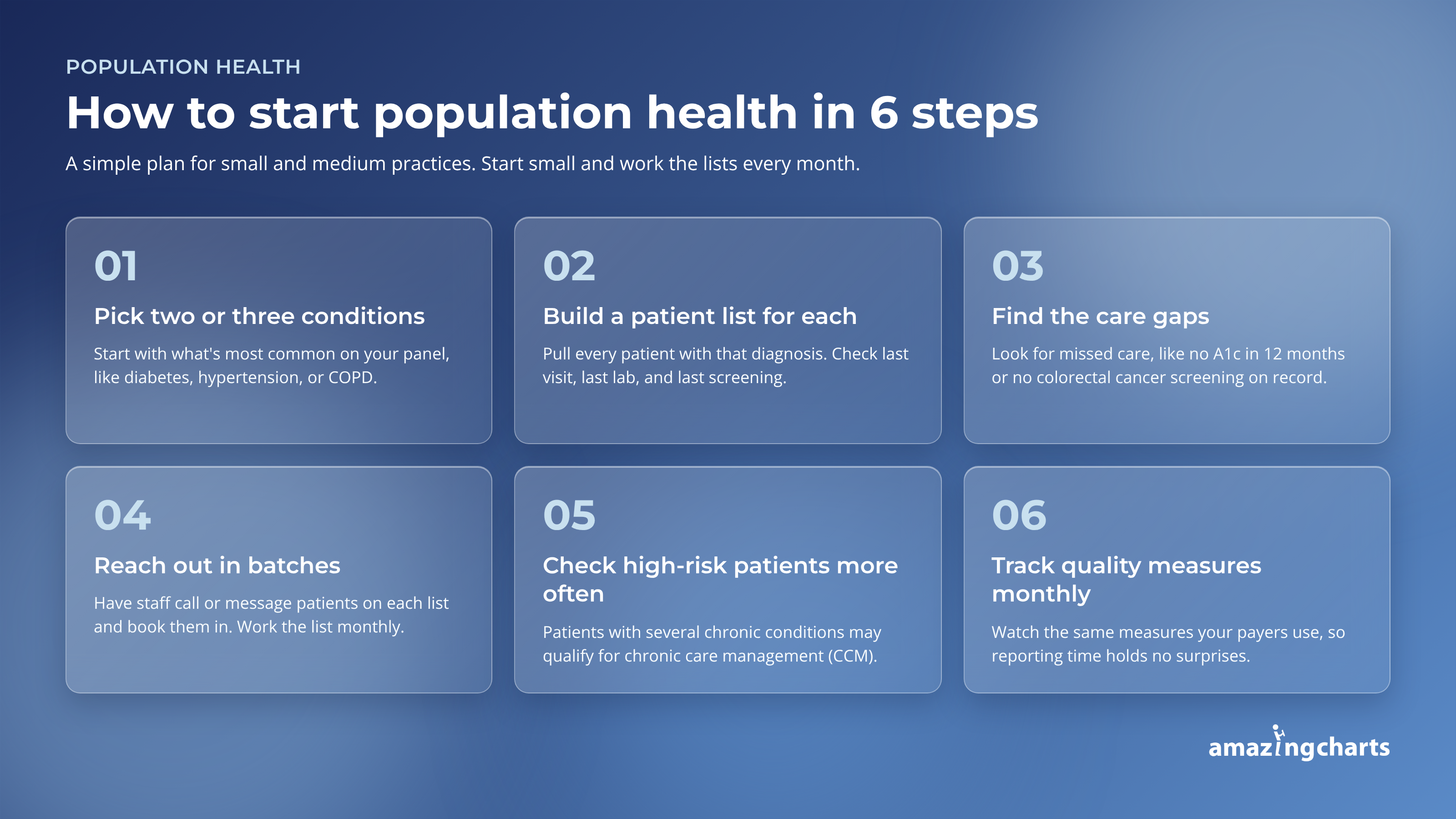
How to start population health in a small practice
Your EHR already holds the data you need. Population health tools turn that data into lists of patients who need something, so your team can reach them before a problem gets worse.
Here's how to start, even with a small team:
- Pick two or three conditions. Start with what's most common on your panel, such as diabetes, hypertension, or chronic obstructive pulmonary disease (COPD). Don't try to track everything at once.
- Build a patient list for each one. Pull every patient with that diagnosis and check the basics: last visit, last lab, last screening.
- Find the care gaps. A care gap is the difference between recommended care and the care a patient actually got. Examples: a diabetic patient with no A1c in 12 months, or a 50-year-old with no colorectal cancer screening on record.
- Reach out in batches. Have staff call or message patients on each gap list and book them in. A list worked once a month beats a perfect plan nobody runs.
- Check high-risk patients more often. Patients with several chronic conditions may qualify for chronic care management (CCM) services, which Medicare pays for separately.
- Track your quality measures monthly. Watch the same measures your payers use, so there are no surprises at reporting time.
This doesn't replace treating one patient at a time. It adds a second view: the whole panel. That view helps you catch the patient who hasn't come in, not just the one sitting in front of you.
Care gaps worth tracking first
If you're not sure where to start, these patient groups are common on primary care panels and tend to have the most missed care. Check the exact ages and intervals against current US Preventive Services Task Force (USPSTF), CDC, and specialty society guidance before you build your lists.
|
Patient group |
What to check |
Why it matters |
|
Patients with diabetes |
A1c, kidney function, eye exam, foot exam |
Missed labs hide worsening control until a complication shows up |
|
Patients with high blood pressure |
Most recent reading at goal, medication refills |
Blood pressure control is a common quality measure |
|
Adults due for cancer screening |
Colorectal, breast, and cervical screening |
Screening gaps are easy to miss and are tracked by payers |
|
Older adults |
Pneumococcal, shingles, and flu vaccines |
The CDC now recommends pneumococcal vaccination for all adults 50 and older |
|
Patients on long-term medications |
Medication review and any monitoring labs |
Older patients on several medications are at higher risk of side effects |
|
Patients with a recent ER visit |
A follow-up visit with your practice |
A quick follow-up can prevent a repeat visit |
Population health tools in Amazing Charts
If you're doing this with spreadsheets and memory today, the hardest part is keeping lists current. Amazing Charts population health pulls patient data straight from the Amazing Charts EHR, so you don't have to build lists by hand.
- Care gaps: see which patients are missing recommended care.
- Clinical quality measures: track the measures tied to Medicare, Medicaid, and other value-based programs, and submit quality data.
- High-risk patients: find patients who need follow-up.
- Chronic care support: care coordination for chronic care management (CCM), behavioral health integration (BHI), and remote patient monitoring (RPM) through a partner, Cosán.
Talk to our team to see how it would work for your patient panel.
Key takeaways
- Better health care helps populations grow mainly by keeping people alive longer.
- In the US, the main effect is an older patient population with more chronic disease.
- Public health covers a whole community. Population health covers a defined group, like your patients.
- Small practices can start population health with two or three conditions, a gap list, and monthly outreach.